

Millions of people sit down every week, part their hair, and massage warm oil into their scalp, believing that this simple ritual is quietly making their hair grow faster. It’s a habit passed down from mothers and grandmothers, repeated so often that nobody stops to question it.
But here’s the uncomfortable question a dermatologist would actually ask you: can oil, applied to the outside of your scalp, really influence how fast a hair follicle produces new strands beneath it?
The honest answer is more nuanced than “yes” or “no” — and understanding it properly will change how you oil your hair for the better.
Why People Have Oiled Their Hair for Centuries
Long before dermatology existed as a science, oiling was already a fixture of daily life across South Asia. In Pakistani households, the Sunday oil massage is practically a rite of passage — a grandmother heating mustard or coconut oil on the stove, calling the children over one by one.

Generations of heritage have anchored warm oil massage as a pillar of personal care and family bonding.
This tradition has deep roots in Ayurveda, the centuries-old system of medicine from the Indian subcontinent. Ayurvedic texts describe “Shiroabhyanga,” or head oil massage, as a practice meant to calm the nervous system, balance body energies, and nourish the scalp. Long before anyone measured cortisol levels or blood flow with modern instruments, this tradition understood something intuitively true: touch, warmth, and consistency matter for the body.
In Pakistan specifically, oils like mustard, sesame, almond, and coconut have been household staples for generations, often prepared at home with herbs like methi (fenugreek) or amla folded in. The practice was never purely cosmetic — it was tied to comfort, bonding, and a belief in prevention rather than cure.
Modern dermatology hasn’t dismissed this tradition. It has simply refined what part of it is actually doing the work.
What Hair Oil Actually Does
Before looking at growth claims, let’s look at what topical oils physically achieve on human hair:
- Reduces friction between strands: Hair fibers rub against each other constantly during sleep, brushing, wind, and daily movement. This friction roughens the outer cuticle layer. Oil coats the hair shaft and lowers this friction, which is why oiled hair tangles significantly less.
- Reduces breakage, not hair loss from the root: These are two very different things. Breakage happens when the hair shaft snaps partway along its length. Hair loss from the root happens at the follicle, under the skin. Oil meaningfully reduces the first; it has far less influence over the second.
- Softens hair and improves manageability: Oils rich in fatty acids penetrate the hair shaft to some degree. Coconut oil is the most researched example here, shown to reduce protein loss from washing because its lauric acid has a strong affinity for hair protein.
- Supports the scalp’s moisture barrier: Just like facial skin, your scalp has a barrier of natural oils and lipids that prevents water loss and blocks irritants. A well-formulated oil replaces lost surface lipids, helping dry or flaky scalps.
Hair Growth vs. Hair Retention
This is the question everyone actually wants answered. Hair grows from follicles embedded in the scalp, following a genetically programmed cycle (Anagen, Catagen, Telogen). On average, healthy scalp hair grows at a fairly fixed rate of roughly 1 to 1.25 centimeters per month, regardless of what you apply externally.
Applying oil to the scalp surface does not change this genetic growth rate. Oil is not absorbed deeply enough, nor does it contain the biochemical signals, to instruct a follicle to divide cells faster than its programmed cycle allows.
The Core Distinction
Hair growth refers to how fast a follicle produces new hair from the root (genetically fixed).
Hair retention refers to how much of that grown hair you actually keep, rather than losing it to breakage, split ends, or shaft damage before it reaches its full length.
If oiling reduces breakage and protects the hair shaft, more of the hair that is growing survives to become visible length. This creates the appearance of “faster growing” hair when what’s really happening is less loss of hair that was already growing.
Understanding Healthy vs. Weak Roots and Follicles
The state of your scalp and hair roots directly determines whether your strands withstand environmental stress or snap prematurely.
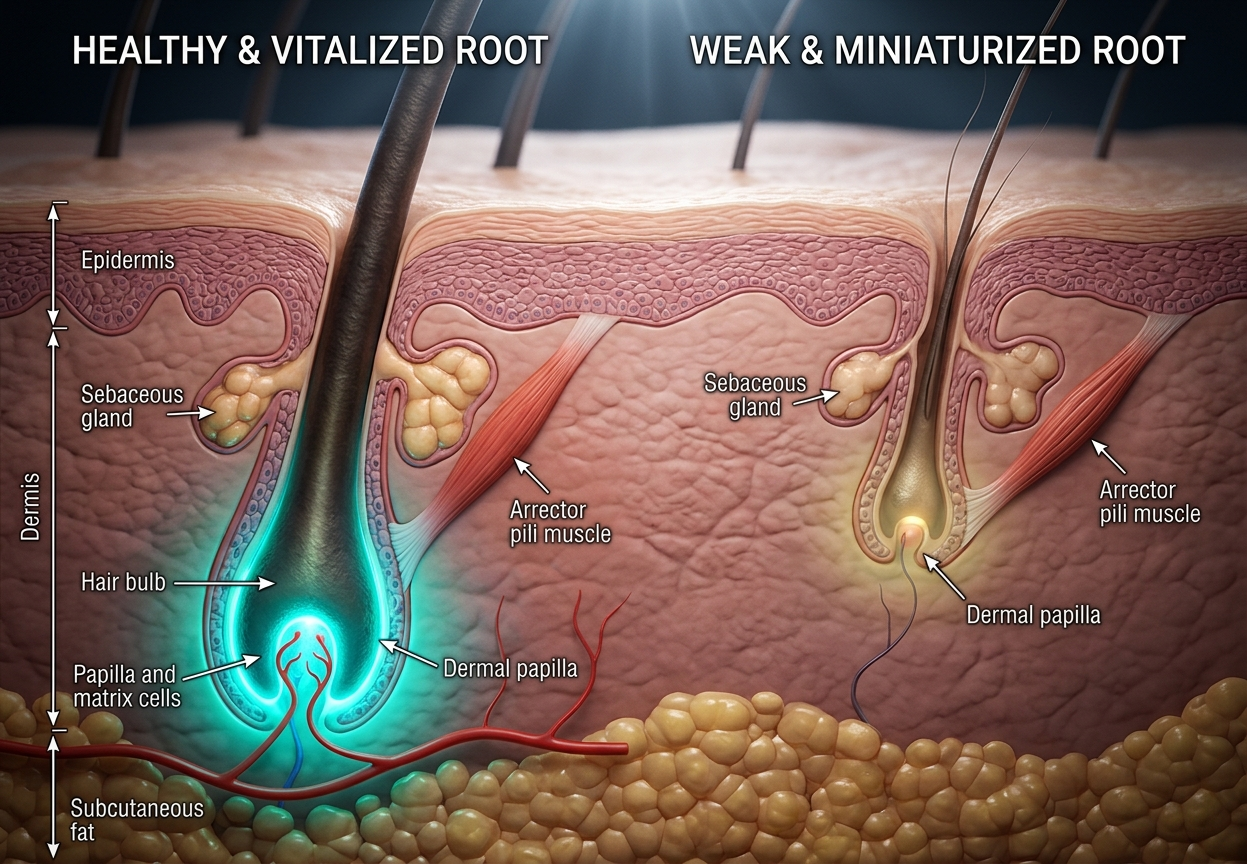
Comparison of a robust, well-nourished hair root versus a depleted, weak follicle prone to premature shedding.
When follicles are anchored in a balanced, well-nourished scalp environment, the cellular matrix receives adequate protection against oxidative stress. Conversely, a dehydrated, irritated scalp compromises the outer root stability. While topical oils cannot override internal genetic hair loss patterns, maintaining a healthy scalp barrier ensures that emerging strands have optimal structural support from day one.
The Power of Scalp Massage
If oil itself has a ceiling on what it can do for growth, scalp massage is where some of the most compelling modern research lives:
- Blood circulation: A small 2016 Japanese study found that a standardized four-minute daily scalp massage over 24 weeks was associated with increased hair thickness by mechanically stretching dermal papilla cells.
- Stress reduction: Chronic stress triggers telogen effluvium, forcing hairs into a premature resting phase. Massage activates a relaxation response, lowering cortisol and supporting the hair cycle.
- Consistency: Doing something gentle and regular for your scalp creates an ideal microenvironment for follicles to thrive.

A transparent look inside premium botanical oil formulation and potent natural extracts.
Common Hair Oiling Mistakes to Avoid
Even a beneficial habit can be undone by poor technique. Watch out for these common errors:
- Applying too much oil: Excess oil sits on the scalp, attracts dust, and traps sweat against follicle openings.
- Leaving oil in for days: Multi-day oiling oxidizes, mixes with sebum, and breeds microbial irritation.
- Using cheap mineral oils: Industrial mineral oils sit on top of the skin without penetrating or offering barrier benefits.
- Oiling a dirty scalp: Applying oil over days of accumulated sweat and product residue suffocates the skin.
- Overwashing afterward: Stripping the hair with harsh shampoos multiple times undoes the natural moisture balance.
Hair Oil Myths vs. Reality
| Common Myth | The Scientific Fact |
|---|---|
| Hair oil grows hair overnight | Hair grows at a fixed rate of ~1 to 1.25 cm per month regardless of topical oils. |
| More oil means better growth | Excess oil clogs scalp pores and traps pollutants rather than improving outcomes. |
| Oil replaces inner nutrition | Topical treatments cannot replace dietary protein, iron, and essential vitamins. |
| Oil cures genetic baldness | No cosmetic oil reverses clinical androgenetic alopecia or deep genetic hair loss. |
| Daily oiling is always best | Frequency should match scalp type; daily heavy oiling can cause buildup and irritation. |
Best Natural Oils for Healthy Hair
Different botanical oils offer distinct molecular advantages:
- Coconut Oil: High lauric acid content provides exceptional protein-loss reduction during washing.
- Sweet Almond Oil: Rich in Vitamin E and fatty acids with a lightweight texture ideal for daily manageability.
- Castor Oil: Viscous and rich in ricinoleic acid, excellent for sealing moisture at fragile hair ends.
- Black Seed Oil: Contains thymoquinone with documented anti-inflammatory and scalp-calming properties.
- Rosemary Oil: Known for stimulating scalp microcirculation and supporting overall hair density.
How RAMI Hair Oil Fits Into a Healthy Routine
Once you understand what oiling can and cannot do, it becomes clear where a premium formulation belongs: not as a miraculous cure-all, but as an essential supportive layer in a comprehensive hair care regimen.
RAMI Hair Oil is formulated using cold-pressed extraction methods designed to preserve the natural integrity of traditional South Asian botanicals without heat degradation. By pairing protective amber glass packaging with pure, targeted carrier oils and time-tested herbs, RAMI supports your scalp’s natural moisture barrier, minimizes friction-induced breakage, and enhances daily manageability.
Pair RAMI Hair Oil with balanced nutrition, proper hydration, and smart scalp hygiene for sustainable, long-term hair health.
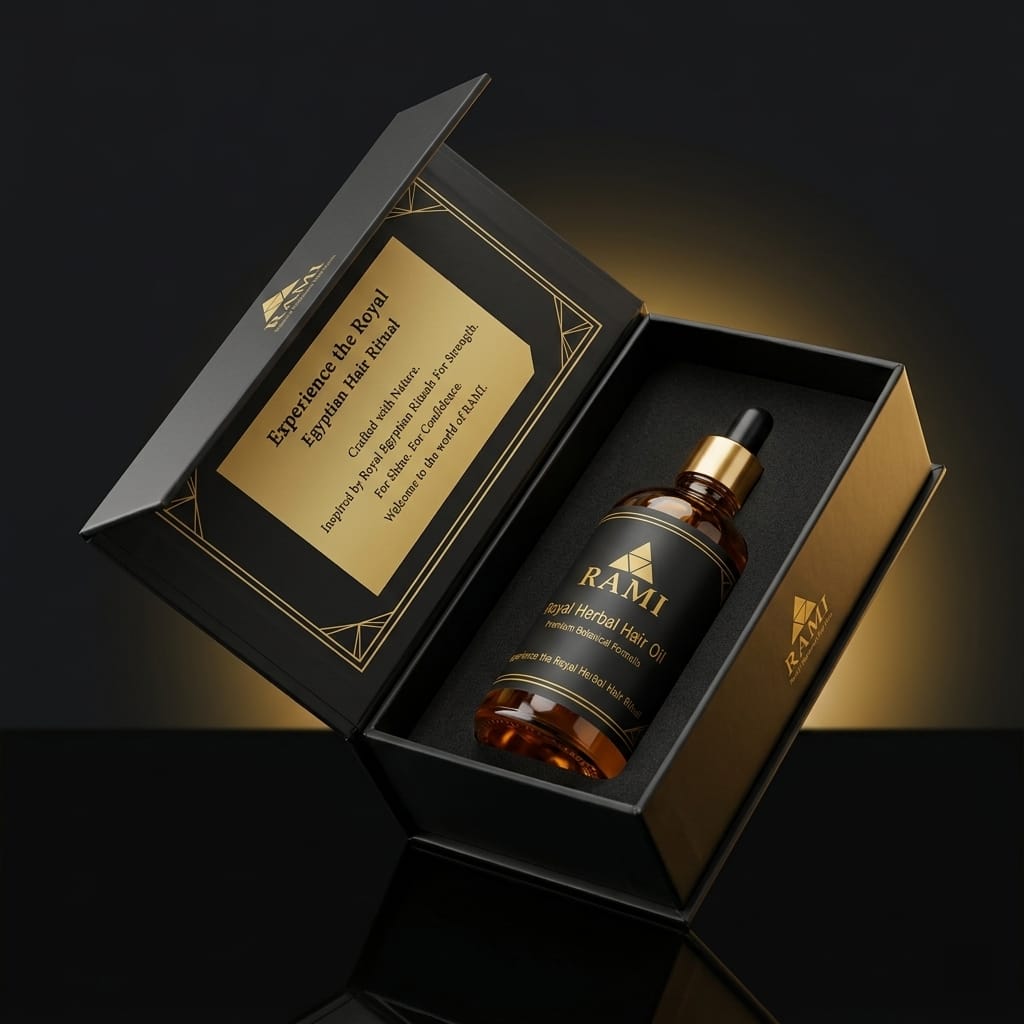
RAMI Premium Royal Herbal Hair Oil
Formulated with rare botanicals and cold-pressed oils, our flagship royal herbal hair oil deeply penetrates the scalp to strengthen hair follicles, eliminate frizz, and promote luxurious, radiant length.
- Deep scalp nourishment & root strengthening
- Controls frizz and adds natural mirror-like shine
- Lightweight, non-greasy everyday formula